
The Regretful Saga of Nuclear Weapons
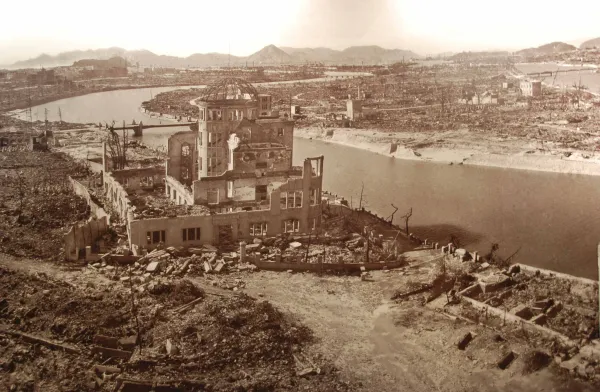
Hiroshima after the bomb: Maarten Heerlien from Voorschoten, The Netherlands, CC BY-SA 2.0 <https://creativecommons.org/licenses/by-sa/2.0>, via Wikimedia Commons
The Nuclear age begins as WWII neared its end
Mitchell Zimmerman reminds us that “the nuclear age began 81 years ago” (https://www.commondreams.org/opinionnuclear-weapons-lies). He writes, it all began with a lie. Zimmerman is an attorney, longtime social activist, and author. Here’s some of what he writes.
“Eighty-one years ago this week, a single American airplane, flying almost unnoticed over a Japanese city, dropped a single bomb that destroyed the entire city. Three days later another American plane destroyed a second city.
“The atomic bombs dropped on Hiroshima on August 6, 1945 and Nagasaki on August 9, 1945 killed 100,000 people outright. By the end of the year another 100,000 succumbed to radiation sickness, burns, and other injuries from the blasts.” Some 90% were civilians.
Zimmerman claims they were the first victims of the bomb but overlooks the effects that people in the US and Marshall Islands suffered from previous tests of the bomb before they were dropped on Japan.
Was it necessary to drop the nuclear bombs?
One side argues that it was necessary to drop the bomb with all its horrendous death and destruction to avoid launching an invasion that would have cost thousands of American soldiers their lives. The other side contends that the Japanese would have surrendered if the Americans had agreed to leave the Emperor in place.
Zimmerman’s position is that we did not have to drop the bombs to force the Japanese government to surrender and to avoid American casualties.
His argument. “Because the United States had broken Japanese military codes, American intelligence learned in July 1945 that the Japanese government had already contacted the Soviet Union, America’s World War II ally, to discuss surrender. The Japanese hoped, above all, to ensure that the Allies’ demand for unconditional surrender did not require the Japanese Emperor to abdicate….”
Zimmerman points out that this was a condition that US eventually agreed to in the end, but only after the bombs were dropped on two Japanese cities.
Zimmerman insists, those who made the decision knew that Japan was seeking to end the war and believed that the entry of the Soviet Union into the war, after the Allies’ victory in Europe, would likely be enough to precipitate Japan’s capitulation. He continues.
“A long-hidden, top-secret US intelligence study in 1946 confirmed that the atomic blasts were not what ended the war—it was Russia’s August 8, 1945 declaration of war against Japan and Soviet troop movements.
“US war leaders confirmed the atomic bombing was not needed. The Supreme Commander of Allied Forces General Dwight D. Eisenhower (later President Eisenhower) concluded that ‘Japan was already defeated and that dropping the bomb was completely unnecessary... no longer mandatory as a measure to save American lives.’”
-----
It’s complicated
Science Insights [SI] contends that the question of why the US dropped atomic bombs on Japan is complicated (https://scienceinsights.org/why-did-the-us-use-atomic-bombs-on-japan). The article was published on March 26, 2026. Here’s some of what you find there.
“The United States dropped atomic bombs on Hiroshima and Nagasaki in August 1945 to force Japan’s immediate surrender and avoid a ground invasion that military planners estimated would cost hundreds of thousands of American lives.
“But that single sentence, while accurate, compresses a decision shaped by military strategy, diplomatic failure, Soviet rivalry, and intense internal debate. The full picture is more complicated than any one justification suggests.
The Military Case for the Bombs
By mid-1945, the war in the Pacific had already killed tens of thousands of American servicemembers in brutal island-hopping campaigns. The battles of Iwo Jima and Okinawa, fought in the first half of that year, offered a preview of what an invasion of the Japanese mainland would look like. Okinawa alone produced over 12,000 American deaths and more than 100,000 Japanese military and civilian casualties.
SI continues. “Against that backdrop, a new weapon offered something no amount of conventional bombing had achieved: the possibility of ending the war in days rather than months. The U.S. had already been firebombing Japanese cities for months, killing hundreds of thousands of civilians. Tokyo was, in the words of the military’s own Target Committee, practically ‘rubble.’ The atomic bomb was not a moral departure from existing strategy so much as a dramatic escalation of it, concentrating destruction into a single device.”
How the Decision Was Made
SI - “The decision to use the bomb was not made in a single meeting. It developed through a series of committees and conversations over the spring and summer of 1945. The most important was the Interim Committee, a group of senior officials and scientists convened by Secretary of War Henry Stimson in May 1945 to advise President Truman on nuclear policy.
“After extensive discussion, the committee reached several conclusions that shaped how the bombs would be used. They agreed the Japanese could not be given advance warning, because a failed detonation or a forewarned defense would undermine the weapon’s impact. They agreed the target should not be a purely civilian area, but that the goal should be to ‘make a profound psychological impression on as many of the inhabitants as possible.’ In practice, this meant selecting cities with military or industrial significance that were still intact enough for the bomb’s power to be unmistakable.”
The Target Committee, a separate group of military officers and scientists, had been meeting since April to identify suitable cities.
Japan’s Rejection of the Potsdam Declaration
“On July 26, 1945, the United States, Britain, and China issued the Potsdam Declaration, demanding Japan’s unconditional surrender and warning of ‘prompt and utter destruction’ if it refused. The declaration did not mention the atomic bomb specifically, nor did it clarify whether Emperor Hirohito would be allowed to remain on the throne, a point of enormous significance to the Japanese government.” Japan’s Prime Minister Suzuki Kantaro issued an ambiguous statement that was interpreted by the U.S. as a rejection of their proposal.
Why the Debate Persists
SI – “Historians have argued over this decision for eight decades, and the disagreement is not just about facts but about how to weigh competing values. Those who defend the bombings point to the enormous projected casualties of an invasion, the refusal of Japan’s military leadership to accept surrender, and the fact that conventional bombing was already killing civilians on a massive scale. Those who criticize the decision point to the Franck Report’s warnings (most of which proved correct), the possibility that Japan was already close to surrender, the role of Soviet entry in pushing Japan toward capitulation, and the moral weight of deliberately targeting cities full of civilians.
“The question is further complicated by the fact that multiple justifications existed simultaneously and reinforced each other. Ending the war quickly, saving American lives, demonstrating the weapon’s power to the Soviet Union, and justifying the $2 billion cost of the Manhattan Project were all factors operating at once. No single explanation captures the full reality. The decision emerged from a convergence of military urgency, diplomatic calculation, technological momentum, and the psychology of leaders who had been at war for years and saw a way to finish it.”
-----
Why drop a second nuclear bomb?
James M. Lindsay addresses this question, Aug 9, 2026
(https://www.cfr.org/article/the-bombing-of-nagasaki).
Did the United States act too hastily in dropping a second atomic bomb on Japan?
“On August 6, 1945, the United States dropped an atomic bomb on Hiroshima, Japan. That first-ever use of an atomic weapon killed an estimated 140,000 people, most of whom were civilians. Three days later, the United States dropped an atomic bomb on the city of Nagasaki. Some 40,000 people, again mostly civilians, died instantly. Another 34,000 died agonizing deaths from radiation poisoning, flash burns, and other injuries in the weeks that followed.
“The decision to use atomic bombs against Japan remains hotly debated. Both attacks subjected civilian populations to horrific devastation with long-lasting effects. The bombing of Nagasaki comes with the additional criticism that it happened too soon after the Hiroshima attack to allow the Japanese government to fully assess what had happened and possibly quit fighting.”
A survey Lindsay conducted on behalf of the Council on Foreign Relations with members of the Society for Historians of American Foreign Relations (SHAFR) ranked the bombing of Hiroshima as the fifteenth-worst foreign policy decision in U.S. history. SHAFR members ranked the bombing of Nagasaki as the tenth-worst foreign policy decision in U.S. history.
The Interim Committee
Lindsay continues. “In May 1945, Secretary of War Henry L. Stimson established an Interim Committee composed of himself and seven other high-ranking officials to advise Truman. They considered and rejected as impractical the suggestion that the United States conduct a non-combat demonstration of the new weapon to warn Japan of what it faced. Their reasoning was straightforward: The United States initially would have only a few working weapons. The demonstration test might be a dud, which could embolden Japan to fight on. If Japan knew the intended target, it might move U.S. prisoners of war to the site or shoot down the U.S. plane carrying the bomb. The Interim Committee instead recommended on June 1, 1945, that the atomic bomb “be used against Japan as soon as possible; that it be used on a war plant surrounded by workers’ homes; and that it be used without prior warning.”
Some Manhattan Project scientists argued against using their creation. The Manhattan Project created the atomic bombs. On June 11, the scientists argued in what became known as the Franck Report that “the release of this new means of indiscriminate destruction upon mankind” would “precipitate the race of armaments, and prejudice the possibility of reaching an international agreement on the future control of such weapons.” Leo Szilard, who had been instrumental in persuading FDR to launch the Manhattan Project, organized a separate petition that seventy Manhattan Project scientists signed. It urged Truman not to drop an atomic bomb on Japan unless Tokyo was first informed of the weapon and given an opportunity to surrender.
Neither the Franck Report nor Szilard’s petition swayed the Interim Committee. In a meeting on June 21, it reaffirmed its recommendation to Truman.
“Truman accepted the recommendation to use what he called ‘the most terrible thing ever discovered’ against Japan. He was in Potsdam, Germany, meeting with British Prime Minister Winston Churchill and Soviet leader Joseph Stalin, when he learned of the successful Trinity Test. On July 26, 1945, Truman and Churchill issued, with the concurrence of Chinese President Chiang Kai-shek, the Potsdam Declaration. Among other things, it declared:
‘We call upon the government of Japan to proclaim now the unconditional surrender of all Japanese armed forces, and to provide proper and adequate assurances of their good faith in such action. The alternative for Japan is prompt and utter destruction.’
Japan’s military-dominated government rejected the Potsdam Declaration.
Hiroshima
The United States carried out the Potsdam Declaration’s threat of “prompt and utter destruction” on August 6 when a B-29 bomber named the Enola Gay dropped an atomic bomb known as Little Boy on Hiroshima, a city of some 350,000 people. As many as 80,000 people died instantly.
Later that day, Truman announced to the world that the United States had developed an atomic bomb. He went on to warn:
“We are now prepared to obliterate more rapidly and completely every productive enterprise the Japanese have above ground in any city. We shall destroy their docks, their factories, and their communications. Let there be no mistake; we shall completely destroy Japan’s power to make war.”
Despite Hiroshima’s destruction, Japan refused to surrender.
Nagasaki, the second target
“A specially equipped B-29 bomber named Bockscar departed from Tinian in the Northern Mariana Islands early on August 9. The crew had nicknamed its cargo, a bomb of a different design than the one dropped on Hiroshima, Fat Man. The crew’s orders were to target Kokura, now Kitakyushu, a city of 130,000 that was home to one of Japan’s largest weapons factories. U.S. bombers had yet to hit Kokura with conventional bombs. That meant that the United States could measure Fat Man’s full destructive power.
“When Bockscar reached Kokura, clouds and smoke obscured the target, the city’s weapons factory. On the plane’s third bombing run, it began to attract heavy antiaircraft fire. Following a pre-established procedure, the B-29 redirected to its secondary target, Nagasaki, a port city with a population of more than 250,000 people. The clouds over Nagasaki broke just as Bockscar arrived. The plane dropped its cargo at 11:01 a.m. local time. Fat Man fell for 47 seconds and then exploded at a height of 1,650 feet.
Japan’s Surrender
The Japanese government communicated its surrender to the United States and its allies on August 10. That morning, Truman had ordered that no further atomic bombs be dropped on Japan. Vice President Henry A. Wallace wrote in his diary:
Truman said he had given orders to stop atomic bombing. He said the thought of wiping out another 100,000 people was too horrible. He didn’t like the idea of killing, as he said, ‘all those kids.’”
“Japan’s surrender came with one condition, that the emperor be allowed to remain as Japan’s ceremonial head of state. Several days of negotiations on the details followed. On August 15, Emperor Hirohito went on national radio to announce Japan’s surrender. It was the first time that most Japanese heard his voice.”
The Ambiguous Legacy of Nagasaki
“The question that hangs over the bombing of Nagasaki, even more so than over the bombing of Hiroshima, is whether it was necessary. Even some people who supported attacking Hiroshima believe the answer is no. As the famed physicist Hans Bethe, who worked on the Manhattan Project, put it: ‘I think it was necessary to drop one, but the second one could have easily been avoided. I think Japan would have capitulated anyway.’”
“Critics of the decision to bomb Nagasaki ask difficult questions. Was three days sufficient time for Japanese leaders to absorb the enormity of what had happened to Hiroshima? Could the United States have done more to persuade them that Japan faced additional atomic bomb attacks? Was the Soviet entry into the war sufficient by itself to convince Japanese leaders to surrender?”
-----
We must remember the enormous harm done by the atomic bombs dropped on Japan as recent treaties are ended.
William D. Hartung and Mari Faines maintain the Anniversaries of Hiroshima and Nagasaki Have Special Meaning in a World Out of Control. August 7, 2026
(https://www.thenation.com/article/world/hiroshima-nagasaki-under-arms-race).
William D. Hartung is a senior research fellow at the Quincy Institute for Responsible Statecraft. Mari Faines is the manager of external affairs and coalitions at Democracy Forward. She previously advised on strategic communications and congressional strategy at the US State Department’s Office of the AUKUS Senior Advisor, and held leadership roles at Global Zero and Physicians for Social Responsibility focused on nuclear nonproliferation and social justice. She holds an MSc from SOAS University of London and a BA from Colgate University.
Here’s some of what they write.
“As the last US-Russia nuclear arms control treaty expires, the anniversaries of Hiroshima and Nagasaki carry renewed urgency for a world edging toward a new arms race.”
“This August marks yet another anniversary of Hiroshima and Nagasaki, but 2026 carries a special weight—for the first time since the Cold War, the United States has no active nuclear arms control treaty with Russia, following the expiration of the New START nuclear arms reduction agreement.
Hartun and Faines continue. “The story of nuclear weapons is more than just the story of scientists working away in secrecy at Los Alamos, or leaders wielding nuclear threats—and, in the case of the Cuban missile crisis, bringing the world to the brink of nuclear war. It is the story of devastation, disease, and death caused by the development and deployment of those weapons, even if they are never used again in warfare. The deadly consequences of nuclear development have fallen most heavily on communities of color, from the dire health consequences of mining uranium in the Congo and the American Southwest, to the generational cancers in communities downwind from nuclear tests, from the Marshall Islands to the American West; communities of color have been disproportionately affected by nuclear testing and warfare.”
“The stories of the civilian victims of nuclear arms racing are increasingly at risk of being rewritten, sanitized, or erased from official histories altogether. The risks posed by the lack of arms control measures and the concerted effort to whitewash the dangers of possessing nuclear weapons, as well as the catastrophe that would come from using them, make nuclear use at some future date more likely. With no treaty framework in place, active global conflicts like the runaway wars in the Middle East and the ongoing war in Ukraine, and coordinated efforts to erase the history of nuclear dangers, we need to treat this anniversary as more than a commemoration or an expression of regret. We need to treat it as a turning point for humanity.
-----
The Genocidal Weapon and the Nuclear Exception
Eric Ross, analyzes “the genocidal weapon and the nuclear exception” on Counter Punch, Aug 11, 2026 (https://www.counterpunch.org/2026/08/11/the-genocidal-weapon-and-the-nuclear-exception).
“It has been eighty-one years since the atomic bombings delivered an unmistakable message. From the ruins of Hiroshima and Nagasaki, humanity was faced with a choice that Martin Luther King Jr. would later describe as one between ‘nonviolent coexistence or violent co-annihilation.’ The intervening decades have made our answer painfully clear.
“As a result, today we live as prisoners consigned to a permanent death row, having organized our world not around a commitment to collective sanity, safety, and security but around the perpetual preparation for collective destruction. The nuclear threat has predictably returned to the center of world politics, from Ukraine and Taiwan to Palestine and Iran.
“From their first use, the atomic bombs were immoral and illegal. Within a matter of years, such weapons would come to be described, in the words of their own architects, as a ‘weapon of genocide,’ one which serves no military end beyond the slaughter of civilians.
“As such, states that possess nuclear weapons cannot be understood as guardians of the international order, represented by the five permanent members of the UN Security Council, but as its greatest threats, outcasts from law and humanity. They are, in the words of Daniel Ellsberg, adherents to no recognizable ethics other than perhaps “a form of Satanism, a worship of unbridled power that gives national leaders the right to gamble with forces that can undo creation.”
“Yet instead of banning the bomb, the postwar international legal order accommodated it, failing to proscribe nuclear weapons, as it has for chemical and biological weapons. The result has been a world in which the capacity to exterminate millions, even billions, of people is treated not as the ultimate international crime but as the ultimate marker of international prestige and a currency of geopolitical power. So long as some states insist upon the legitimacy of their own atomic arsenals then, efforts to abolish them will remain, however well intentioned, little more than ‘rearranging deck chairs on the Titanic.’”
“Instead of being prohibited, the bomb was rendered outside the law. At Nuremberg and Tokyo, the U.S. established a legal exceptionalism that insulated nuclear weapons, and the strategic bombing that first made them conceivable, from meaningful scrutiny. Prosecutors opted to omit these crimes entirely, rendering them beyond the reach of law. Universal justice, in short, was subordinated to political expediency.”
------
The Delusion of Strategic Stability in a Nuclear World
John Burroughs argues there can be no way to exist peaceably as long as nuclear bombs exist, Aug 16,2026 (https://www.commondreams.org/opinion/delusion-nuclear-stability).
Burroughs is senior analyst for the New York City-based Lawyers Committee on Nuclear Policy. Here are excerpts from his article.
“Suppose for a moment that reliance on nuclear arms by the United States and other nuclear powers will produce “strategic stability” for the rest of this century. That is, that there will be no nuclear war or war on a major scale between the nuclear powers.
Burroughs poses questions. “Is that a world we should want to live in, a world where security depends on the potential for the devastation of entire societies, a world where we are supposed to live moral lives in the context of an immoral system of global security? My answer is no.” Is the concept of “deterrence” sufficient to prevent a nuclear? Again, no.
“It is a fantasy that reliance on nuclear arms can be counted upon to produce stability indefinitely. That can be demonstrated just by looking at today’s conflicts. The Russian invasion of Ukraine in violation of the United Nations Charter was preceded by Russian President Vladimir Putin’s threat to resort to nuclear weapons should Western states intervene in support of Ukraine. Then in the fall of 2022, it was credibly reported that that the Biden administration believed that the Russian government was operationally moving toward the use of nuclear weapons.
“The US attack on Iran, another violation of the UN Charter, has been accompanied by President Donald Trump’s bluster about wreaking society-ending devastation on Iran, evoking the possibility of use of nuclear weapons. Whether or not his nuclear bluster is specific and credible enough to be considered a “threat” as a matter of international law, it certainly runs counter to the notion that use of nuclear weapons is out of the question.
Burroughs continues. “Nuclear deterrence involves the readiness to inflict massive devastation on other societies, even if targets are said to be military. It is planning and preparation for the commission of war crimes and crimes against humanity and in some cases crimes against peace. Crimes against peace concern aggressive war. The use of nuclear weapons to initiate an aggressive war would certainly be a crime against peace. But there is a good case that the first use of nuclear weapons by a state defending itself would be so escalatory and disproportionate as to be a crime against peace.
“A broader view of the Nuremberg principle of individual responsibility is that citizens are acting in accordance with that principle when they take responsibility for preventing nuclear war. That can be done in many ways. One is non-violent protest, as took place August 6 outside the Livermore nuclear weapons laboratory in California.
“Reliance on nuclear arms by the United States and other states means that the world is in a state of risk, immorality, and illegality. The imperative is to end that state of affairs. These bombs must be abolished.
“One positive example. “In 2017, non-nuclear weapon states negotiated the Treaty on the Prohibition of Nuclear Weapons (TPNW). One hundred states are now signatories, not including, however, any nuclear-armed states. Whether the TPNW will serve as a vehicle for the nuclear-armed states to accomplish the elimination of nuclear weapons is open to doubt; they probably would create their own vehicle. Without question, though, the TPNW is a marvelous statement of the principles that should motivate and guide the achievement of a world free of nuclear weapons. The first review conference of the TPNW will be held late this year.”
Burroughs concludes: “the reality is that nuclear abolition, probably in conjunction with other arms control and with changes in global governance, is by far the best way to address the risks, immorality, and illegality of reliance on nuclear arms.”
-----
Concluding thoughts
The story of nuclear weapons begins in the United States. The U.S. government under the presidency of Franklin D. Roosevelt gave the greenlight for the Manhattan project to build a bomb to commence, the first atomic bombs were then created and tested, and, under dubious assumptions, the bombs were subsequently used to blow up two Japanese cities, causing massive destruction, death, and lasting radiation illnesses. The testing and development of nuclear bombs continued, as did the costs to people and the environment. Sadly, the U.S. and other nuclear-armed countries are now in the process of “modernizing” their nuclear arsenals. This is despite the fact that the majority of countries in the U.N. General Assembly have voted to ban nuclear weapons. Meanwhile, the U.S. unfortunately maintains a ‘first use’ policy with respect to nuclear weapons and, as president, Trump has the power to launch nuclear weapons.